

From Event Detection to Behavioral Intelligence: The Future of Fleet Safety
Why event-based alerts fail. Learn how behavioral intelligence + video telematics reduce false alarms, predict fatigue, and enable proactive fleet safety.



Subscribe now
Blind-spot risk is no longer just a driving issue, it has become a systemic challenge in fleet safety management. As commercial vehicles become larger and operate in increasingly dynamic environments, they create persistent safety, technological, human, and regulatory challenges for fleet managers.
Urban congestion, mixed-use streets, and construction zones make situational awareness difficult, while large vehicles create extensive blind spots. These conditions increase the likelihood of collisions with vulnerable road users and costly incidents. For fleet managers, proactive intervention is essential to prevent accidents.
Conventional mirrors, cameras, and standalone sensors often fail to detect moving VRUs or subtle obstacles. Modern fleets increasingly rely on AI-powered integrated blind spot systems that alert drivers and feed into fleet-wide safety workflows, aligning with the emerging trends toward data-driven safety solutions.
Driver fatigue, distraction, or inconsistent adherence to procedures significantly heighten accident risk. Even advanced systems cannot fully mitigate hazards without timely driver response. Training, monitoring, and feedback remain critical yet are often overlooked.
Blind spot safety is now legally mandated across Europe, the UK, India, and China, with deadlines for systems such as BSIS, MOIS, ADDW, and ADAS. Non-compliance can lead to fines, registration denial, and higher insurance costs. Compliance has become a core pillar of fleet risk management and financial protection.
To better understand how these challenges impact real operations, and how they can be addressed, consider the following example:
In a government-led urban infrastructure project, an engineering fleet operated in a densely populated construction environment with complex and constantly changing conditions.
Vehicles frequently performed low-speed turning, roadside stopping, reversing, and start-stop maneuvers. These operations created persistent blind-spot risks due to mixed traffic, large vehicle obstructions, and low-light working conditions.
After deploying the Streamax blind-spot safety solution, the fleet experienced a clear shift in operational performance:
Fewer risk incidents: Risk events decreased significantly. Drivers reported greater confidence in using the system during daily operations, with alert reliability sufficient to support sustained usage.
Improved situational awareness: Enhanced visibility and awareness enabled on-site teams to better coordinate vehicle movements, reducing operational friction across the project environment.
Strengthened stakeholder trust: Beyond operational improvements, enhanced safety capabilities helped the fleet build stronger trust with project stakeholders, government authorities, and surrounding communities, improved access to more projects and business growth opportunities. This also contributed to easing insurance pressure and reducing claims associated with safety incidents.
This transformation showed how blind-spot safety can move from passive risk exposure to active risk management.
Today, blind-spot safety is not just about visibility. Modern fleets are increasingly demanding higher standards for blind spot safety, shifting from seeing risks to accurately identifying risks, delivering timely alerts, and enabling manageable and traceable safety management across the entire fleet. Without these capabilities, vehicles remain vulnerable to collisions, operational disruptions, and rising insurance costs.
Modern blind-spot safety is no longer just about visibility, it requires the ability to accurately identify risks, deliver timely alerts, and support traceable safety management across the fleet.
To address this, Streamax provides an integrated blind-spot detection solution covering the full workflow:
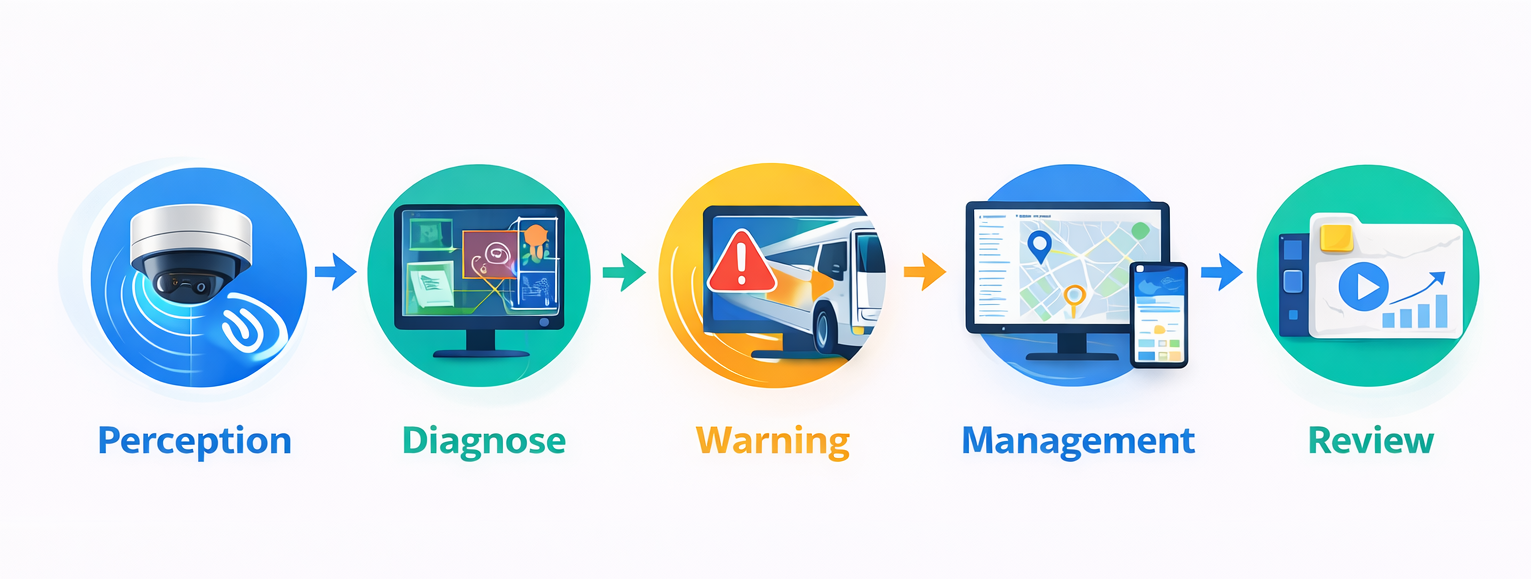
By combining camera, radar, and AI vision technologies, continuously monitors the vehicle surroundings, identifies potential hazards, and alerts drivers in real time. Compared with single-sensor approaches, this multi-layered system delivers more stable and reliable performance, even in complex or low-visibility environments.
|
Capabilities |
Description |
|
Multi-sensor perception |
Integrates multiple sensors, including high-definition cameras and radar, with AI vision to continuously monitor the vehicle’s surroundings. |
|
Fusion algorithms |
Improves accuracy by integrating multiple sensor inputs |
|
Behavior recognition |
Identifies different types of road users, including pedestrians, cyclists, and other vehicles, and recognizes their movement patterns to predict potential collision risks. |
|
Low-light enhancement |
Enhances visibility during nighttime or low-light operations, ensuring reliable hazard detection regardless of lighting conditions. |
|
Scenario filtering |
Reduces nuisance alerts by focusing on real risk situations |
Blind-spot safety does not end at the vehicle level. Streamax integrates with a cloud platform that provides fleet-wide monitoring and management:
Remote live viewing: Supervisors can monitor vehicle operations in real time.
Event playback and incident review: Past events are recorded for post-incident analysis.
Risk analysis and driver training: System data supports driver coaching and operational safety improvements.
Centralized fleet management: Fleet operators can oversee safety performance across all vehicles, enabling proactive decision-making.
This connectivity transforms blind-spot safety into a continuous, data-driven operational capability, allowing managers to continuously optimize safety practices and driver performance.
Rather than repeating incident-level improvements, the broader value lies in how fleets operate over time.
The Streamax solution enables fleets to build a more proactive and structured safety management approach, one that shifts from reacting to incidents to preventing them.
By providing more reliable detection and minimizing false alerts, fleets increase driver trust and encourage consistent use of safety systems. Integrated data and centralized management further enable informed decision-making, standardized operations, and long-term performance optimization. These enhancements also reduce incident-related losses, easing insurance costs and claims pressure.
Ultimately, blind-spot safety becomes more than a compliance requirement, it becomes a strategic advantage that supports safer, more efficient, and more predictable fleet operations.
Beyond warning drivers, what management value does the solution bring to fleet operators?
In addition to in-vehicle alerts, the solution connects with a cloud platform for remote live viewing, event playback, incident review, risk analysis, driver coaching, and centralized fleet management. This allows blind-spot safety to evolve from a single-vehicle feature into a fleet-wide safety management capability.
Why are traditional mirrors and basic camera systems still insufficient in complex fleet operating environments?
In real-world operations, blind-spot risk is not only a visibility issue. It is a dynamic safety problem influenced by vehicle movement, surrounding targets, road conditions, and the timing of driver decisions. Traditional mirrors and basic camera systems mainly provide visual assistance, but they still depend heavily on the driver to continuously observe, interpret, and react. In environments such as urban curbside operations, construction zones, mining sites, or school-bus stops, risks can form within seconds as pedestrians, cyclists, or vehicles move unpredictably around the vehicle. What fleets increasingly need is not just more visibility, but a system that can identify actual risk situations and provide timely, reliable warnings when critical maneuvers occur.
How does the system reduce nuisance alerts instead of simply detecting objects?
The solution does not rely on single-camera visibility alone. By combining cameras, radar, and AI vision with fusion algorithms and scenario filtering, it can better distinguish real hazards from non-critical objects or movements. This helps reduce nuisance alerts, improves driver trust in the warnings, and supports more stable long-term system usage.
What types of vehicles and operating scenarios is the blind-spot detection solution suitable for?
The solution is designed for commercial vehicle operations in complex environments, including urban transit, municipal service fleets, construction vehicles, mining fleets, waste-management vehicles, and school buses. It is especially valuable in scenarios involving frequent turning, reversing, pull-over stops, start-off maneuvers, mixed traffic, and limited visibility.

Subscribe now

